
HarvestGroup360
© 2026 HarvestGroup360 — a brand operated by AMII LTD.
Discover the critical architectural separation in quantitative finance: why Python dominates machine learning research while C++ remains essential for low-latency execution.
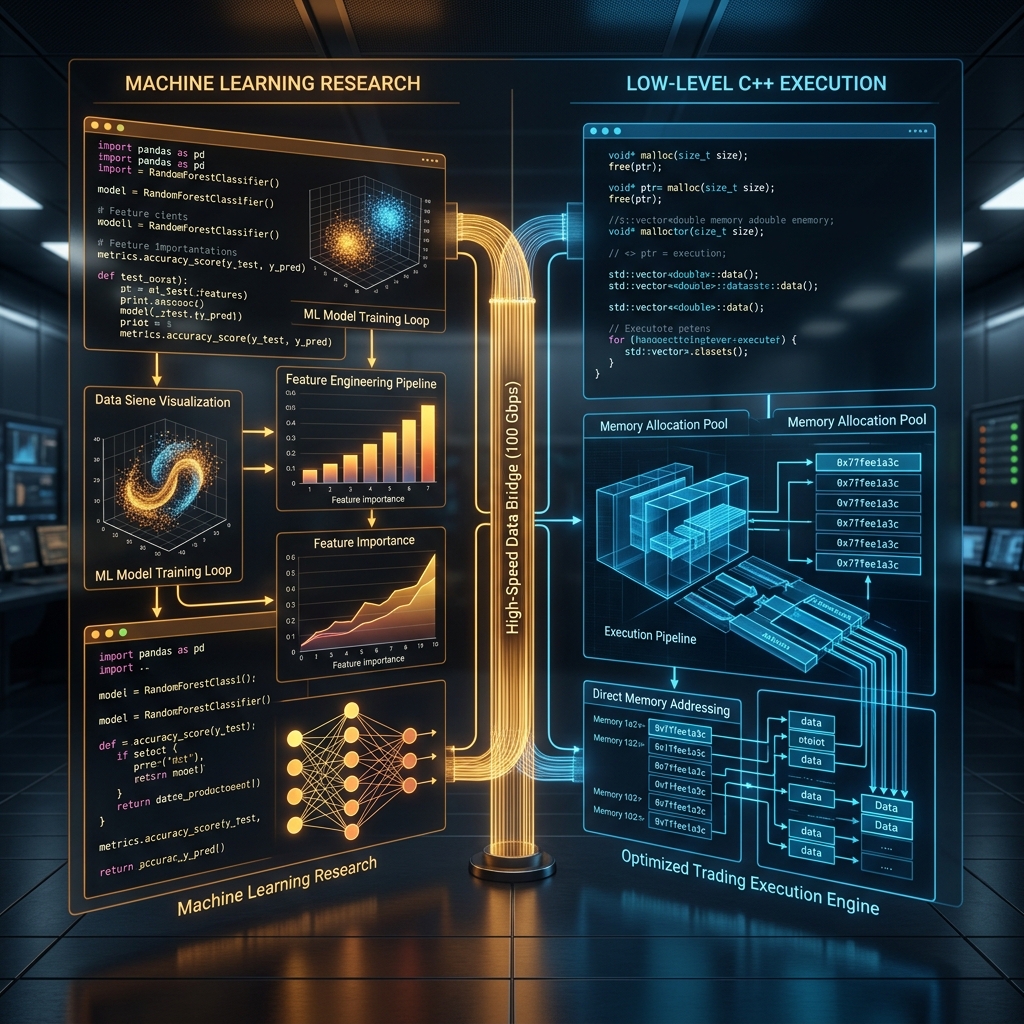
A perennial debate in algorithmic trading is the choice of programming language. Should you build your system in Python or C++? The institutional answer is simple: you must use both, but you must draw a hard architectural line between them.
Python has won the data science and machine learning wars. With libraries like Pandas, NumPy, Scikit-learn, and PyTorch, Python provides an unparalleled ecosystem for exploring data, engineering features, and training predictive models. The developer velocity in Python allows quantitative researchers to test dozens of hypotheses a day.
However, Python is an interpreted language with a Global Interpreter Lock (GIL) and unpredictable garbage collection. When your model generates a signal, attempting to route a FIX message to an exchange using Python means you are entirely at the mercy of the interpreter's scheduling. In a world where order book dynamics change in microseconds, a garbage collection pause is a death sentence for your alpha.
This is where C++ takes over. Once a model is trained and validated in Python, the execution logic—order routing, risk management, and market data parsing—must be handled by a compiled, systems-level language. C++ allows engineers to manage memory allocation explicitly, bypass the OS kernel, and pin threads to specific CPU cores.
By deploying the trained weights of a Python model into a C++ execution harness, you achieve the best of both worlds: the rapid iteration speed of Python research and the deterministic, microsecond-level latency of C++ execution. Where exactly that line falls is a measurement rather than a preference. When we were asked to port our own open-source library to a compiled language, we benchmarked it before writing anything, and the figure that decided the question was not the one anyone expected.
At HarvestGroup360, we have built a seamless bridge between these two domains. Our clients can perform deep research on historical Level 3 data using our Python APIs, train their models, and then deploy those strategies directly into our C++ execution environment located in tier-1 data centers.
Don't compromise on execution speed just because you research in Python. Build on an architecture designed for the realities of modern market microstructure.
Leverage our C++ execution engine while writing your strategies in pure Python. Explore our APIs today.